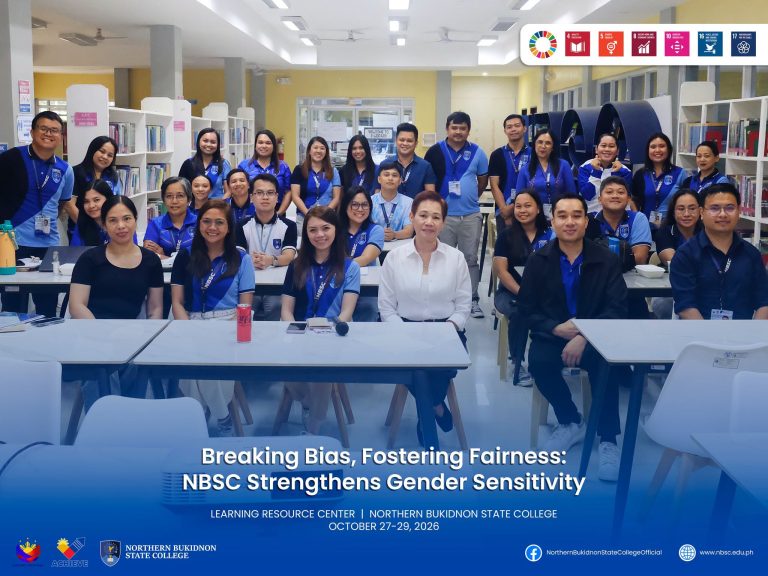
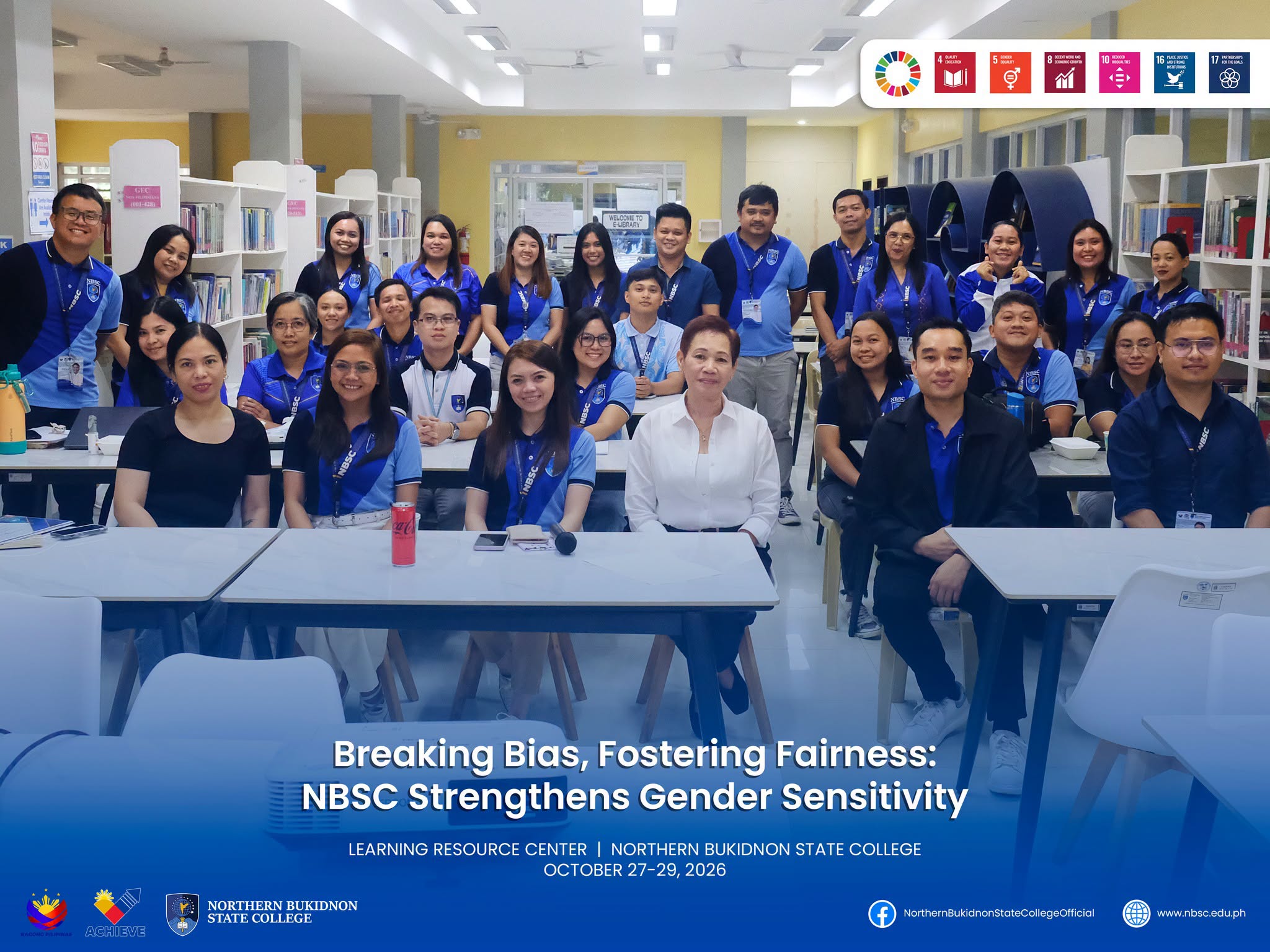

Northern Bukidnon State College (NBSC), through its Gender and Development Office (GADO), conducted a three-day Gender Sensitivity Training on October 27-29, 2026, at the Learning Resource Center (LRC). Dr. Rowena Antoniette Moonyeen S. Navera served as the resource person for the activity, which aimed to deepen participants’ understanding of gender-related issues and raise awareness of how gender shapes personal relationships, social interactions, and institutional practices.
The training opened with remarks from College President Christie Jean Villanueva-Ganiera, Ed.D., CESE, who reaffirmed NBSC’s support for gender and development initiatives. On the first day, Dr. Navera discussed the history of the women’s movement, sex and gender, and gender role socialization. Her discussions traced the evolution of gender-related perspectives and explored how social expectations influence individual roles and behavior.
Participants also took part in an activity involving five scenarios in which they had to decide whom to prioritize among a man, a woman, a senior citizen, a person with disabilities, and an LGBTQ+ person. The exercise encouraged participants to examine the reasoning behind difficult choices and consider how personal assumptions can shape their judgments.
The second day focused on the gender division of labor and the examination of gender bias. Video presentations served as discussion starters, followed by a large-group sharing session where participants exchanged observations and experiences. Family relationships emerged as a recurring theme, prompting discussions on how gender expectations shape household responsibilities, influence decision-making, and affect family interactions.
On the final day, Dr. Navera discussed gender, power, and development, highlighting the relationship between gender considerations and institutional practices. The session also examined the functionality of the Gender and Development Focal Point System (GFPS) and its role in advancing gender-responsive initiatives within the College.
To assess the GFPS’s current functionality, participants were divided into three groups, each tasked with evaluating the system. Their assessments provided an opportunity to review existing practices, identify areas for improvement, and explore ways to strengthen the GFPS’s role in advancing gender and development initiatives.
Through the training, NBSC reaffirmed its commitment to fostering a campus environment grounded in fairness, respect, and gender responsiveness. With the continued support of the College’s leadership and the initiatives of GADO, NBSC aims to translate gender awareness into concrete actions and institutional practices that uphold the dignity of every member of the academic community and respond to diverse needs and experiences.
Written by: Alliana Isa E. Vivares
Photos by: Alliana Isa E. Vivares, Jan G. Soriano