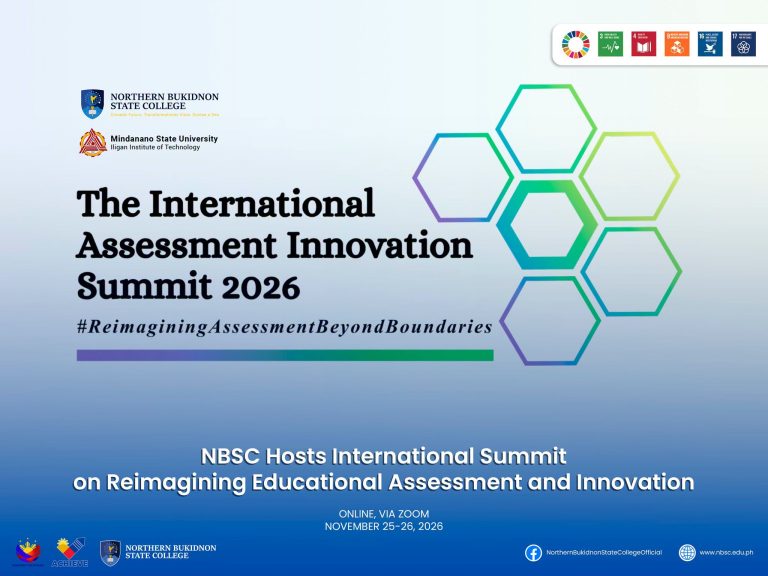
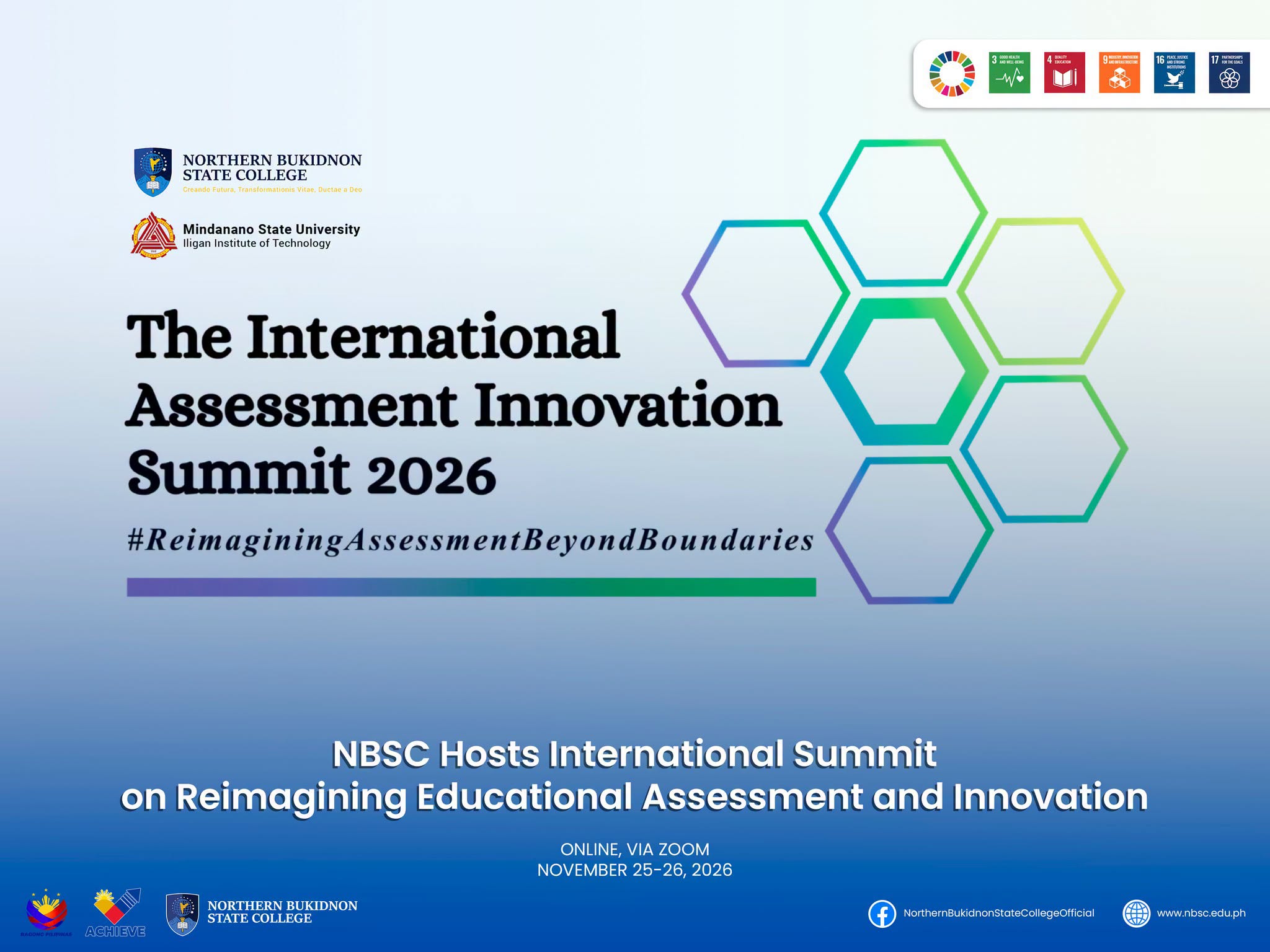

Northern Bukidnon State College (NBSC), in collaboration with Mindanao State University-Iligan Institute of Technology (MSU-IIT), hosted the two-day International Assessment and Innovation Summit (IAIS) 2026 via Zoom on November 25-26, 2026. With the theme reflected in its hashtag, #ReimaginingAssessmentBeyondBoundaries, the summit brought together participants from various higher education institutions to exchange ideas, share research, and explore new approaches to educational assessment.
Welcoming the participants to the summit, Mr. John Kevin A. Artuz, JD, Vice President for Administration and Finance, formally opened the event and acknowledged the presence of the participating speakers, researchers, and representatives from various higher education institutions.
Dr. Christie Jean Villanueva-Ganiera, CESE, in her inspirational message, reminded everyone that what worked in the past may no longer meet the needs of future learners. She emphasized that true institutional transformation does not happen simply through the introduction of new technologies and systems but also through thinking differently, working together, and sharing responsibility for improvement.
Meanwhile, Dr. Jovelyn G. Delosa, Vice President for Academic Affairs, shared the rationale behind the summit, emphasizing assessment literacy as a powerful tool in understanding and connecting with learners.
The first keynote session featured Dr. Francis Ben, Associate Professor from Tabor College, Adelaide, Australia. He discussed how educational assessments can support holistic learner development in a fast-changing VUCAD2 (Volatile, Uncertain, Complex, Ambiguous, Diverse, and Disruptive) world. He also emphasized the use of data and learning analytics in shaping responsive policies and building accountable and resilient academic institutions.
In the afternoon, the second keynote session featured Dr. Jerome A. Ouano, Associate Professor from De La Salle University, Manila, Philippines. He highlighted the connection between assessment, academic anxiety, and emotional well-being, emphasizing the need for learner-centered assessment practices that go beyond grades and promote academic persistence and psychological resilience. This was followed by the first plenary presentations, where participants from various learning institutions presented their research works.
On the second day, the third keynote session featured Dr. Amelia T. Buan, Dean of the College of Education (CED) at Mindanao State University – Iligan Institute of Technology, Iligan City, Philippines. She explored how artificial intelligence (AI) and learning analytics can improve assessment practices in higher education, support institutional growth, and create more inclusive and digitally resilient learning environments. The session was followed by the second round of plenary presentations.
The fourth keynote session featured Dr. Jovelyn G. Delosa of NBSC, who explained how Rasch Analysis helps make test and survey results more accurate and reliable by measuring learner ability in relation to the difficulty of assessment items. Another keynote speaker, Dr. Ir. Utomo Budiyanto, MKom, MSc., Assistant Professor from Budi Luhur University, Jakarta, Indonesia, presented Generative AI for Future Education. He discussed its practical applications in teaching and learning and the importance of integrating these technologies responsibly to create more adaptive learning environments. The third round of plenary presentations followed.
As the summit came to a close, Mr. Reynan S. Salo, MAPsy, TSM, IAIS 2026 Secretariat, delivered the closing message. He emphasized that assessment is more than just a score. It helps educators better understand learning, guides learners in recognizing their next steps, and allows teachers to make more informed decisions in improving instruction.
Through IAIS 2026, NBSC continues to open opportunities for academic exchange and collaboration with institutions beyond its immediate community. By bringing together educators and researchers to share their work and perspectives, the College contributes to ongoing conversations on improving educational assessment and making learning more responsive to the needs of every learner.
Written by: Jan G. Soriano
Photos by: Welcon Bendijo