
NBSC STRENGTHENS RESEARCH ETHICS CAPACITY THROUGH THREE-DAY TRAINING-WORKSHOP IN CEBU CITY
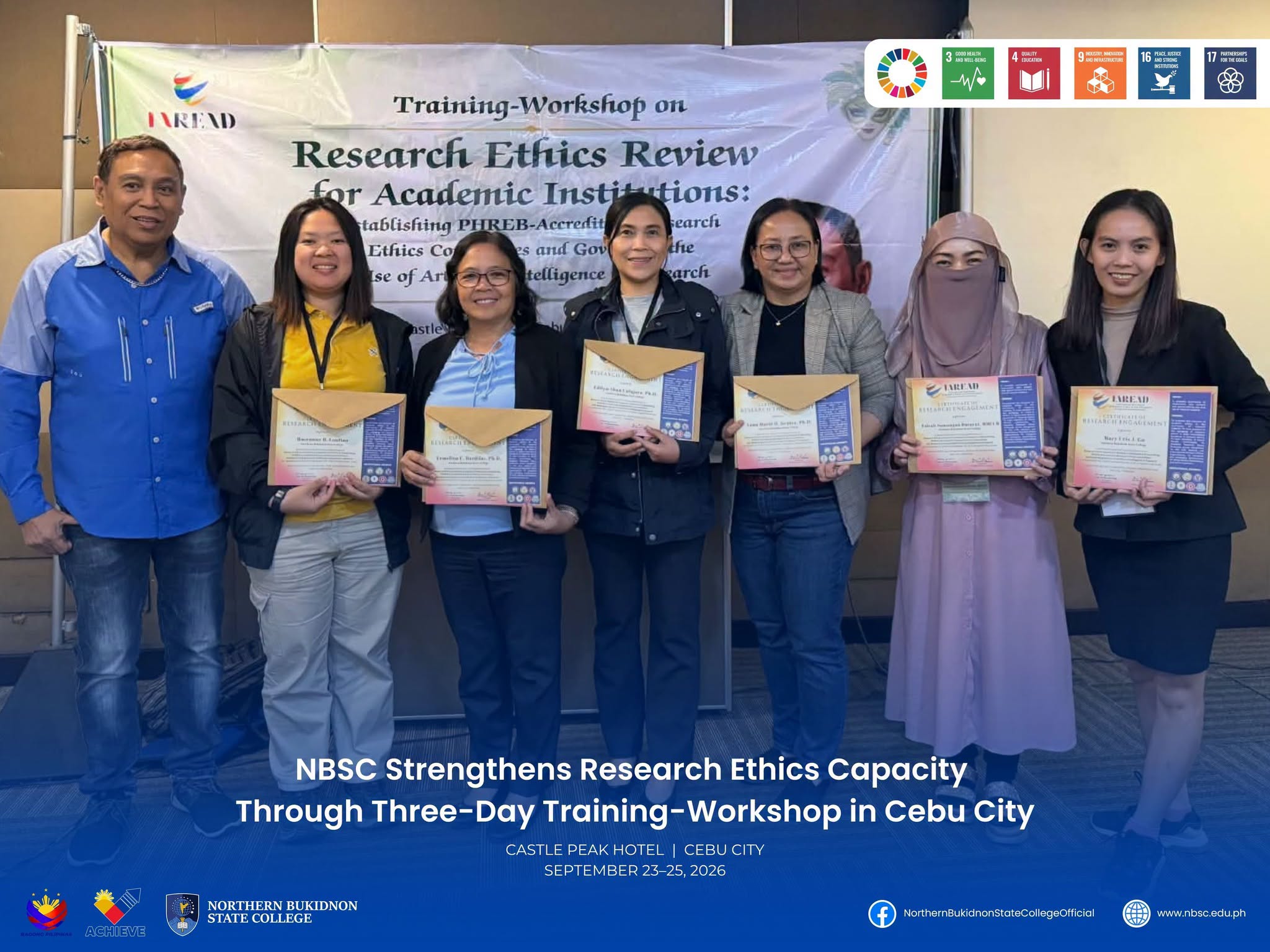
Northern Bukidnon State College (NBSC) strengthened its institutional capacity in research ethics and responsible research through its participation in the Training-Workshop on Research Ethics Review for Academic Institutions: Establishing PHREB-Accreditable Research Ethics Committees and Governing the Use of Artificial Intelligence in Research, held on September 23–25, 2026, at Castle Peak Hotel, Cebu City.
The three-day training-workshop featured Renan P. Limjuco, PhD, PHREB-CIDTA Research Ethics Trainer and Professor at Davao Doctors College and Brokenshire College, Davao City. The sessions focused on key principles, standards, and practical considerations in establishing, strengthening, and sustaining research ethics review systems in academic institutions.
Representing NBSC were:
· Anna Marie D. Genita, PhD – Head, Research Ethics Office
· Ermelina C. Bardilas, PhD – Chair, Research Ethics Committee
· Roseanne B. Lontian, MBM – Vice Chair, Research Ethics Committee
· Mary Cris J. Go, PhD – Member-Secretary, Research Ethics Committee
· Edlyn A. Culajara, PhD – DGEC-REC Coordinator
· Faisah S. Bacarat, MMITM – ICS-REC Coordinator
The training covered essential areas of research ethics, including the National Ethical Guidelines for Research Involving Human Participants, research integrity, technical and ethics review, ethical considerations across various research designs, vulnerability and risk-benefit assessment, informed consent, confidentiality, data privacy, publication ethics, and the research ethics review process.
The participants also gained insights into the constitution and operation of Research Ethics Committees, PHREB registration and accreditation requirements, and the development and implementation of Standard Operating Procedures (SOPs). These discussions are particularly relevant to NBSC’s continuing efforts to strengthen its research ethics system in preparation for PHREB Level 1 accreditation.
A key component of the workshop was the discussion on Artificial Intelligence in research, covering responsible AI use, its capabilities and limitations, confidentiality and accountability, risks of fabrication, AI-assisted qualitative inquiry, AI disclosure, and institutional policies governing the use of AI in research.
Beyond technical knowledge, the training provided the NBSC delegation with an opportunity to reflect on existing practices and identify areas for further improvement in the College’s research ethics governance. It also reinforced the importance of a shared institutional understanding of research ethics, with the Research Ethics Office (REO) providing administrative and coordination support, and the Research Ethics Committee (REC) fulfilling its role in the ethical review and oversight of research involving human participants.
The knowledge, insights, and outputs gained from the training will support the continuing enhancement of NBSC’s research ethics policies, procedures, documentation, and capacity-building initiatives.
Through these continuing efforts, NBSC reaffirms its commitment to upholding the rights, safety, dignity, and welfare of research participants while fostering responsible, ethical, and high-quality research within the institution.
Written by: Research Ethics Office
Photos by: Research Ethics Office