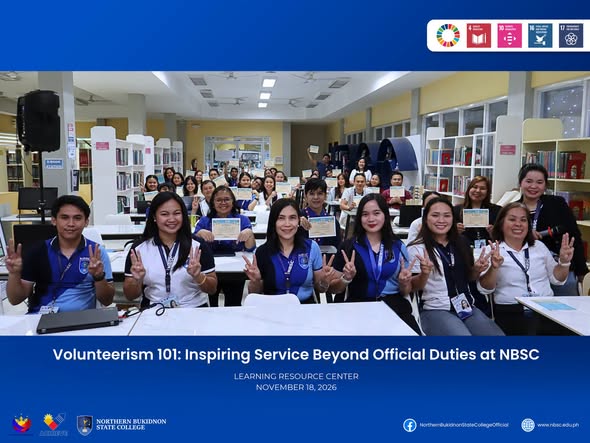

Northern Bukidnon State College (NBSC) conducted “Volunteerism 101: A Volunteerism Training and Cascading Activity for the Non-Teaching Personnel of Northern Bukidnon State College” on November 18, 2026, at the Learning Resource Center (LRC). The activity aimed to strengthen the personnel’s understanding of volunteerism and encourage their involvement in community service.
The program opened with a welcome message from John Kevin A. Artuz, MS, JD, Vice President for Administration and Finance, who encouraged participants to look beyond the responsibilities and rewards associated with their respective jobs. He acknowledged that government service often calls for personnel to respond to the exigencies of service. However, he also encouraged them to find fulfillment in sharing what they have, giving their time, and extending help to those in need.
College President Christie Jean Villanueva-Ganiera, Ed.D., CESE, followed with a message that invited participants to reflect on their own experiences of helping others. She asked them to recall the last time they had done something for someone, pointing out how easily such moments can be overlooked amid daily responsibilities. She also expressed her appreciation to Project Leader Leah Mae S. Cuyno, MSc, and the project members for their efforts in organizing the activity.
The volunteerism training, facilitated by Edilyn A. Culajara, Ph.D., began with a discussion on the background of the Philippine National Volunteer Service Coordinating Agency (PNVSCA). Through an interactive activity, participants were encouraged to recognize their personal experiences with helping others.
Dr. Culajara then discussed the context, definitions, and key principles of volunteerism, drawing from the United Nations Volunteers (UNV) and the International Labour Organization (ILO). She connected these concepts to the Filipino value of bayanihan, derived from bayan and bayani, describing it as service for the greater good rooted in love for others.
The discussion also covered the reasons people choose to volunteer, including personal values, self-esteem enhancement, personal development, concern for the community, and the desire to understand others. Dr. Culajara emphasized that everyone has something to offer, whether through their talent or skills, time, or treasure. She also explained that volunteerism is a valuable strategy in public service, particularly because government institutions may not always have sufficient resources to address every community need.
Regardless of one’s motivation, level of commitment, or way of serving, one message remained clear: volunteerism changes lives. At its heart, volunteerism is about caring for others, about love, and about service freely given out of love.
To help translate these principles into practice, participants were given time to accomplish a Skills and Talent Inventory. This was to identify the abilities and interests they would be willing to share in future volunteer activities.
The activity also featured a lighthearted icebreaker centered on the question, “Who made you smile today, and what did that person do to make you smile?” Participants were encouraged to recall the people whose simple gestures had brightened their day. The activity offered a reminder that kindness does not always require grand gestures and that even small acts can make a meaningful difference.
The CESD Cascading Activity, facilitated by Leah Mae S. Cuyno, MSc, provided an overview of the College’s 2026 CESD Community Outreach initiatives. The presentation highlighted NBSC’s efforts in reaching communities and the contributions of its members in bringing smiles to the people they serve. Cuyno also discussed upcoming CESD activities, with their schedules to be shared with personnel through email.
The challenge now lies in turning the participants’ renewed understanding of volunteerism into meaningful involvement in future community initiatives. As its personnel bring the spirit of volunteerism into their respective roles and community engagements, NBSC moves toward a more responsive and compassionate approach to public service, where the impact of its work is felt not only within the institution but also in the lives of the people it reaches.
Written by: Alliana Isa E. Vivares
Photos by: Alliana Isa E. Vivares